- PCD Tools For Wood
- Replaceable Insert Router Bits
- CNC End Mill
- Cutter Head
- Woodworking Tools
- Industries Knives
- Carbide Burr
- Carbide Rotary Burr
- Tungsten Carbide Burr Bits
- Tungsten Carbide Burr Set
- Cylindrical Carbide Burr
- Long Shank Carbide Burr
- Double Cut Carbide Burr
- Flame Carbide Burr
- Cone Carbide Burr
- Burr Blanks
- Carbide Rods
- Tire Reamer Bit
- Tungsten Carbide End Mill
- Carbide Tire Studs
- Snow Tire Studs
- ATV Tire Studs
- Motorcycle Tire Studs
- Mining & Oiling

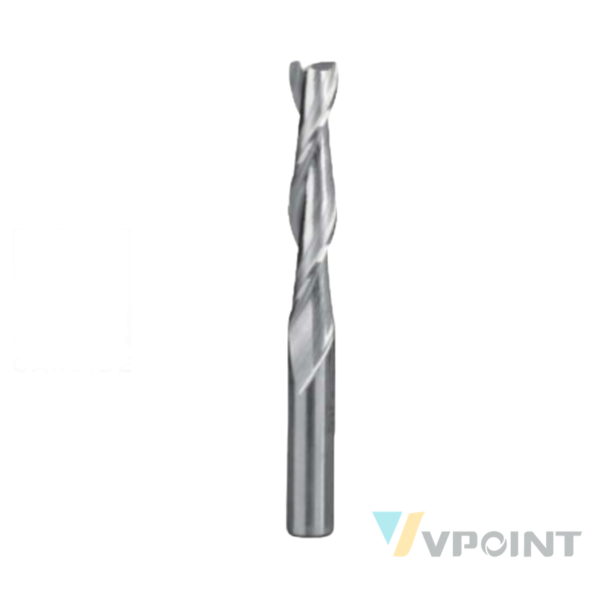

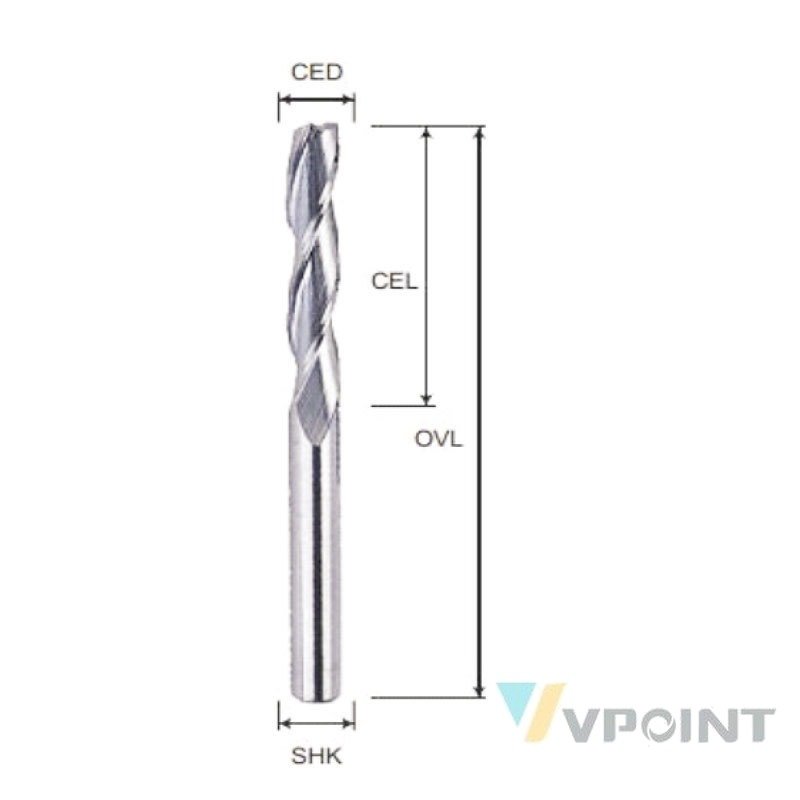
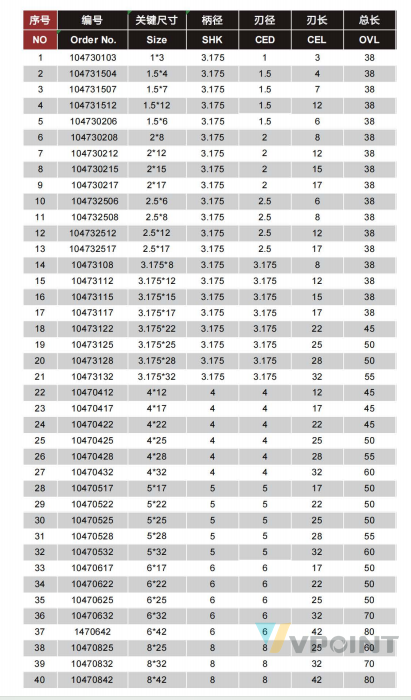
Performance Data — a VPOINT end mill tool for CNC milling, sized for plywood and similar workpieces. The specification table below lists dimensions; the performance data table gives standard reference speeds and feeds to start with, and the FAQ covers selection, parameters and service. ISO 9001 production, batch-verified, custom sizes from drawings.
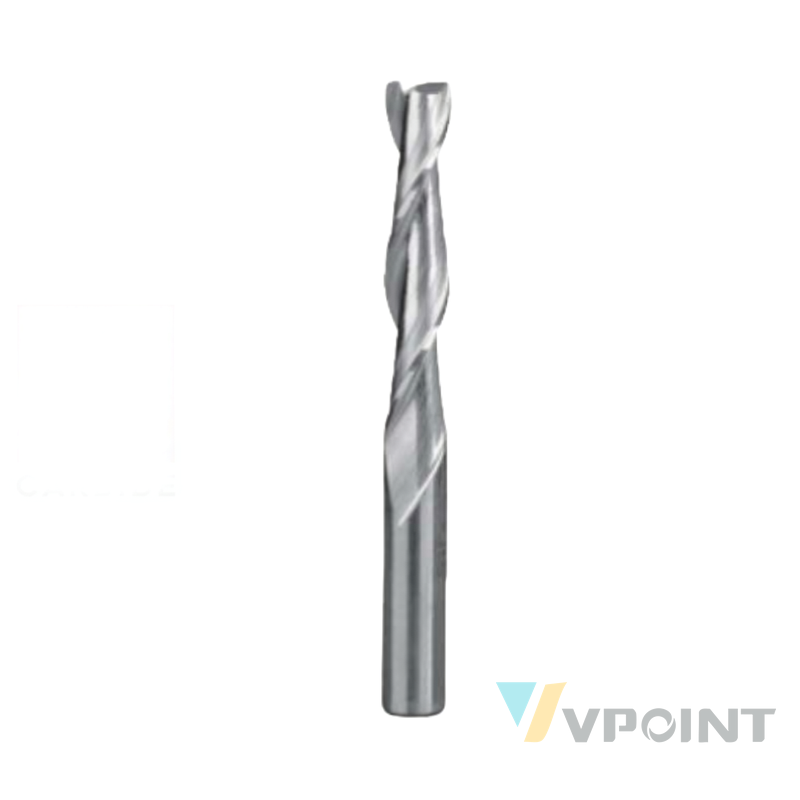
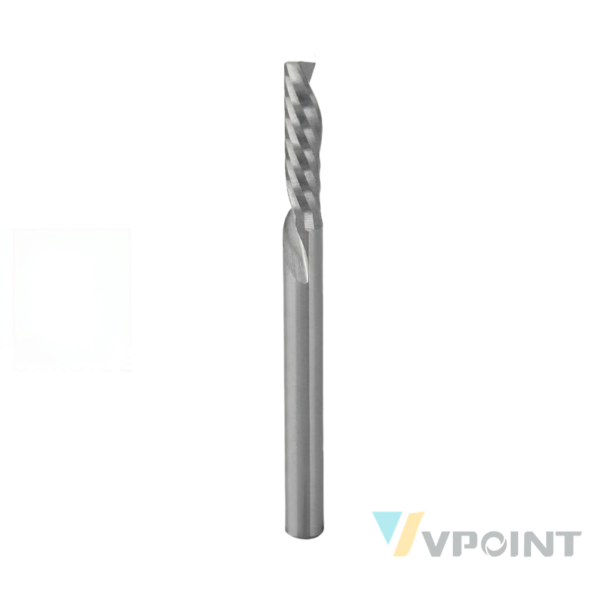
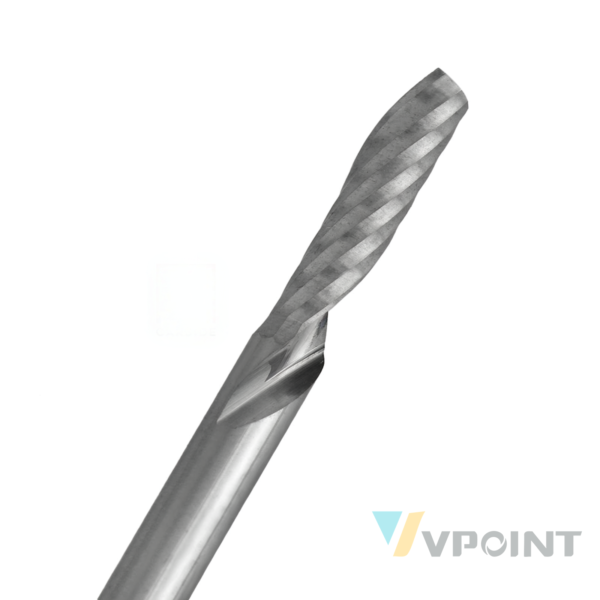
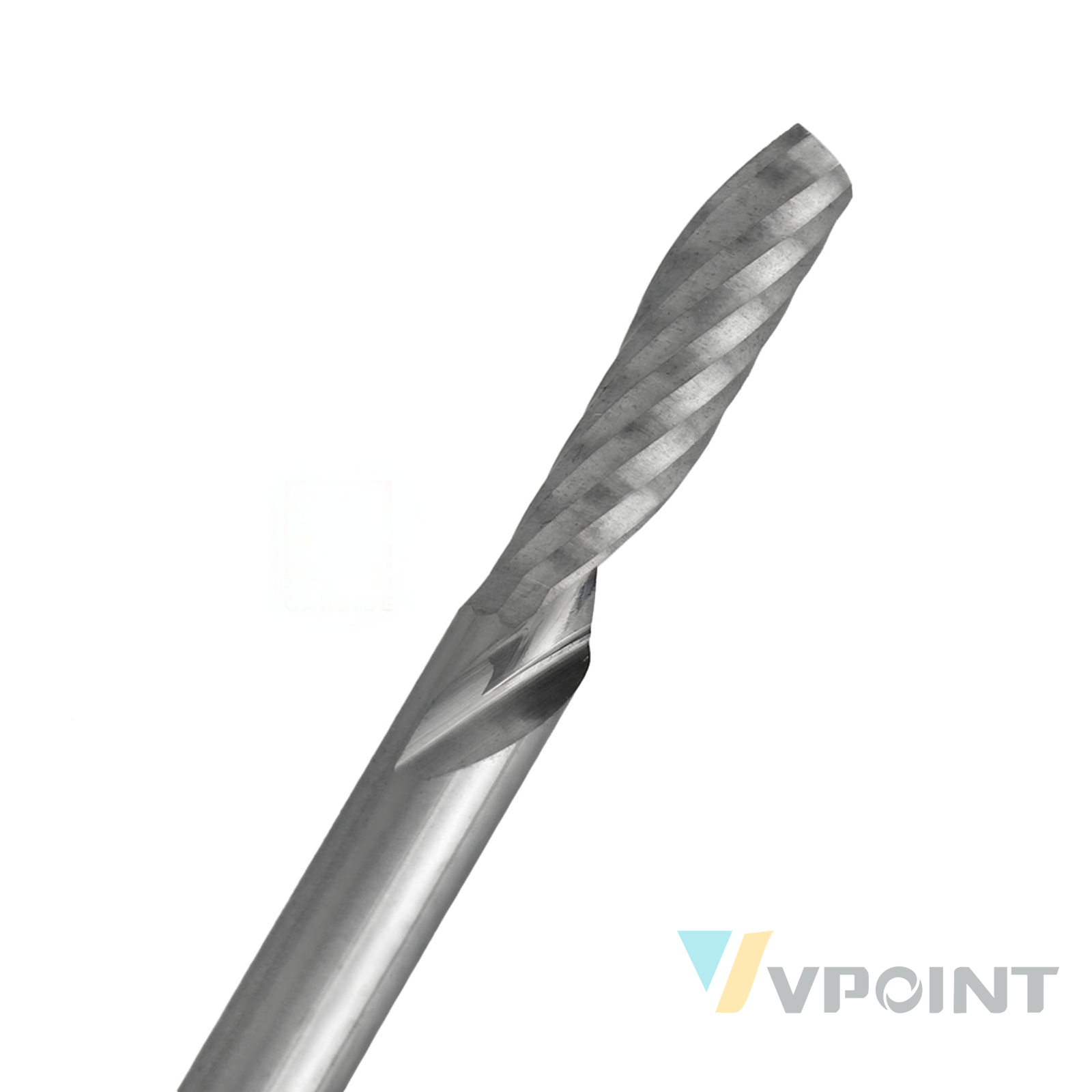
VPOINT Single Spiral Flute Downcut End Mills are manufactured in Sichuan and Dongguan, China, with a single-flute downcut spiral that presses chips downward for clean top surfaces, low heat generation and smooth finishes on woodworking panels.
A downcut end mill pushes chips down into the cut instead of lifting them up. That keeps the top surface of the sheet clean: fibers stay pressed where the edge exits, so laminates and veneered panels come out splinter-free on the show side. Use it when the top face is the face that matters.
A single spiral flute downcut end mill is a cutting tool built for clean top surfaces. The spiral runs the opposite way to an upcut bit: the edge presses material down as it cuts, which is what stops veneer and laminate lifting at the edge.

Features and Benefits
Features:
-
Single Flute Design:
- Sharp Cutting Edge: The single flute provides a sharper, more aggressive cutting action, making it ideal for softer materials.
- Larger Chip Clearance: The single flute leaves more room for chips to travel, so the bit clogs less on long cuts.
-
Downcut Spiral:
- Pushes Chips Downward: The downcut spiral pushes chips and debris down into the material rather than pulling them up, keeping the top surface clean.
- Minimized Tear-Out: The edge presses fibers down as it cuts, so the top surface stays smooth and splinter-free.
-
Low Heat Generation:
- A single flute runs with less friction, which matters for plastics, wood and composites: materials that deform or melt when heat builds up.
-
Surface Finish:
- Clean Top Finish: Leaves a clean top surface on laminates, plywood and veneer, where the show face is the top face.
- Precision and Stability: The tool delivers highly precise cuts with reduced vibration, ensuring better control and accuracy.
Common Applications:
-
Woodworking:
- Ideal for use in CNC routers for tasks like grooving, slotting, or profiling wood, particularly when the top surface needs to remain smooth.
- Excellent for cutting plywood, MDF, laminates, and veneers where tear-out on the top surface is a concern.
Material Comparison: Downcut Single-Flute End Mill vs. Upcut Single-Flute End Mill
The downcut spiral flute enters the panel downwards and compresses the fibres instead of lifting them. That difference decides the result on plywood and veneered board, where a lifted face tears out.
| Property | Downcut Single-Flute Solid Carbide End Mill (This Tool) | Upcut Single-Flute Solid Carbide End Mill |
|---|---|---|
| Cutting action | Downcut: the edge enters downwards and compresses the fibre layer | Upcut: the edge lifts material upwards on exit |
| Panel behaviour | Compression keeps the top veneer seated against the spoilboard, so the face stays flat | On veneered stock the visible face can lift and tear out at the exit |
| Chip evacuation | Single wide flute clears chips out of the cut | Same single-flute geometry, but chips leave upwards |
| Workpiece support | Works best with the sheet held down on a spoilboard or vacuum table | Needs firm support, because the material is pushed up as it is cut |
| Typical workpiece | Plywood, veneered board and laminated panels | Solid timber, board materials and freehand routing |
| Best suited for | CNC cutting of plywood and veneered panels where the visible face must stay flat | All-around CNC profiling where entry and exit are open |
A downcut flute is the safer choice in plywood and veneered panel work because it presses the sheet down; an upcut single flute is the better match for freehand profiling in solid timber. An HSS version of the same geometry is still practical on clean wood, but on plywood veneers the solid-carbide flute lasts several times longer between regrinds.
Performance Data
Standard reference values for guidance only — always adjust to machine rigidity, clamping and tool wear, and confirm on the actual workpiece.
| Material | Typical spindle speed | Typical feed | Notes |
|---|---|---|---|
| plywood | 16,000–20,000 rpm | 5–8 m/min | Keep the compression or shear geometry inside the panel |
| veneered board | 18,000–20,000 rpm | 5–7 m/min | Light finish passes protect the veneer |
Frequently Asked Questions
What spindle speed suits plywood?
Begin near 16,000–20,000 rpm with the feed around 5–8 m/min, then tune by chip load and finish. Rubbing means raise the feed; burning means drop it.
Up-cut or down-cut for this job?
Up-cut pulls chips up and away but can fuzz the top face; down-cut presses the top face down. Match the flute direction to the face you care about.
How deep can I cut in one pass?
Stay within the cutting length and keep passes inside the listed geometry; deeper single passes raise deflection and heat.
Where do these reference values come from?
They are standard reference ranges for this tool family, compiled from our specification sheets and common workshop practice — always confirm on the actual workpiece.
Key words: solid carbide end mill, CNC end mill, compression router bit, upcut spiral bit, downcut spiral bit, single flute end mill, two flute end mill, spiral flutes end mill, slotting end mill, profiling end mill, steel slotting cutter, aluminium end mill, acrylic end mill, nano coating end mill, corn milling cutter, edge rounding cutter, flat bottom end mill, ball nose end mill, 1-10 flutes end mill, DLC coated end mill, end mill for carbon steel, end mill for stainless steel, furniture manufacturing, furniture factory, cabinet making, acrylic sheet, solid wood, particleboard, chipboard, plywood, rubber sheet, rubber board, hardwood, softwood, MDF, HDF, melamine board, laminated board, flycutter, planing bit, surfacing bit, slab flattening bit, bottom cleaning bit, spoilboard leveller, rabbeting bit
Sources & standards: ISO 9001 quality management · UNSPSC commodity codes · eClass product classification
Related Search Terms
solid carbide end mill, CNC end mill, compression router bit, upcut spiral bit, downcut spiral bit, single flute end mill, two flute end mill, spiral flutes end mill, slotting end mill, profiling end mill, steel slotting cutter, aluminium end mill, acrylic end mill, nano coating end mill, corn milling cutter