- PCD Tools For Wood
- Replaceable Insert Router Bits
- CNC End Mill
- Cutter Head
- Woodworking Tools
- Industries Knives
- Carbide Burr
- Carbide Rotary Burr
- Tungsten Carbide Burr Bits
- Tungsten Carbide Burr Set
- Cylindrical Carbide Burr
- Long Shank Carbide Burr
- Double Cut Carbide Burr
- Flame Carbide Burr
- Cone Carbide Burr
- Burr Blanks
- Carbide Rods
- Tire Reamer Bit
- Tungsten Carbide End Mill
- Carbide Tire Studs
- Snow Tire Studs
- ATV Tire Studs
- Motorcycle Tire Studs
- Mining & Oiling

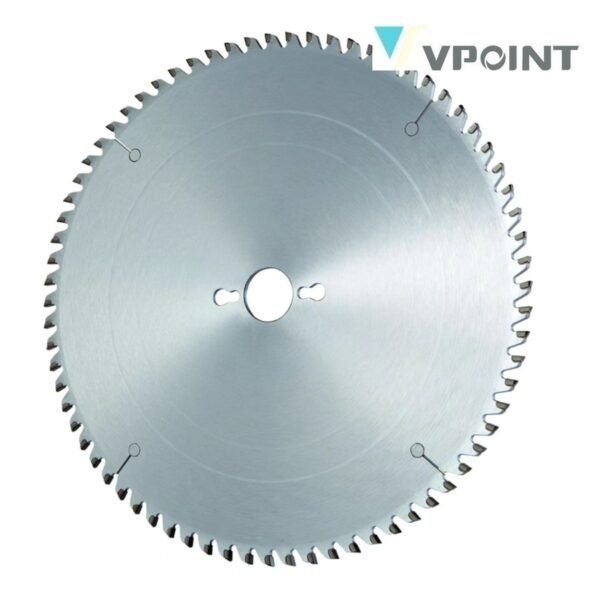
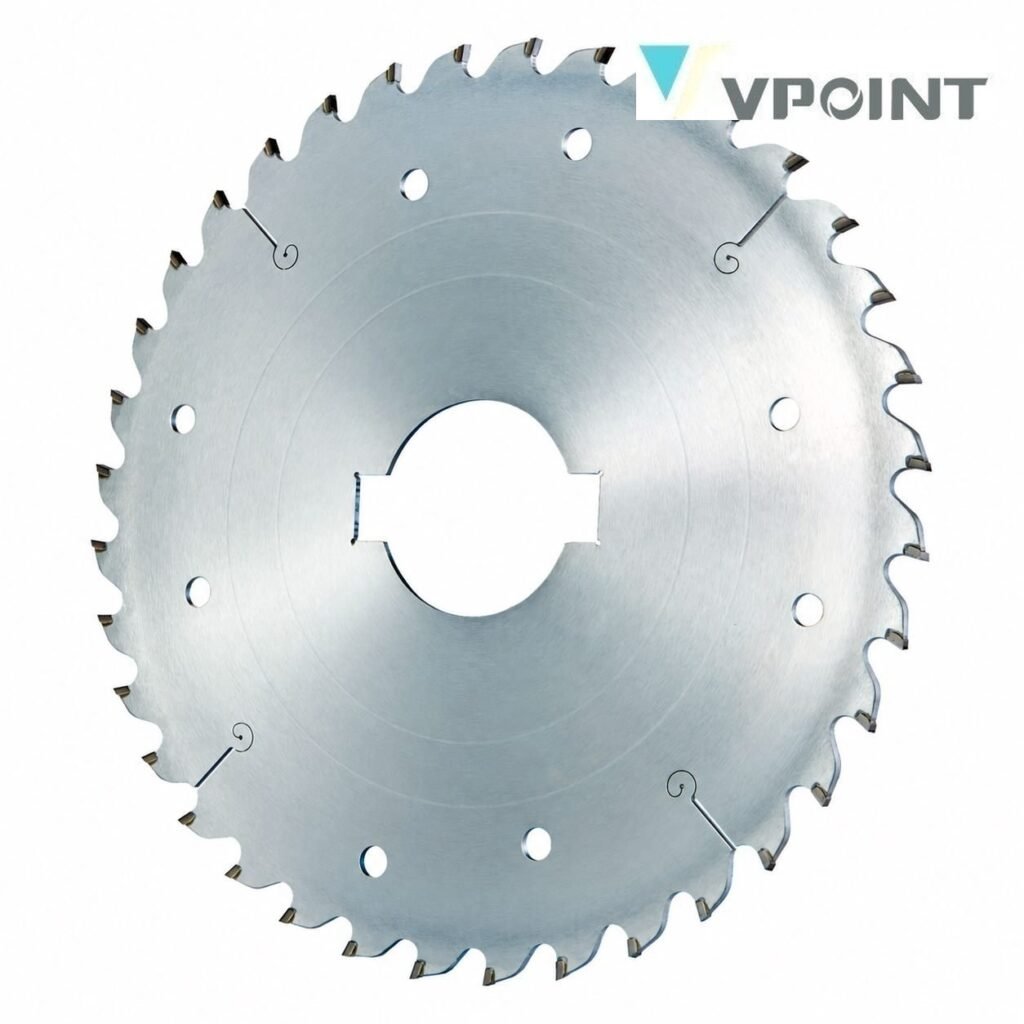
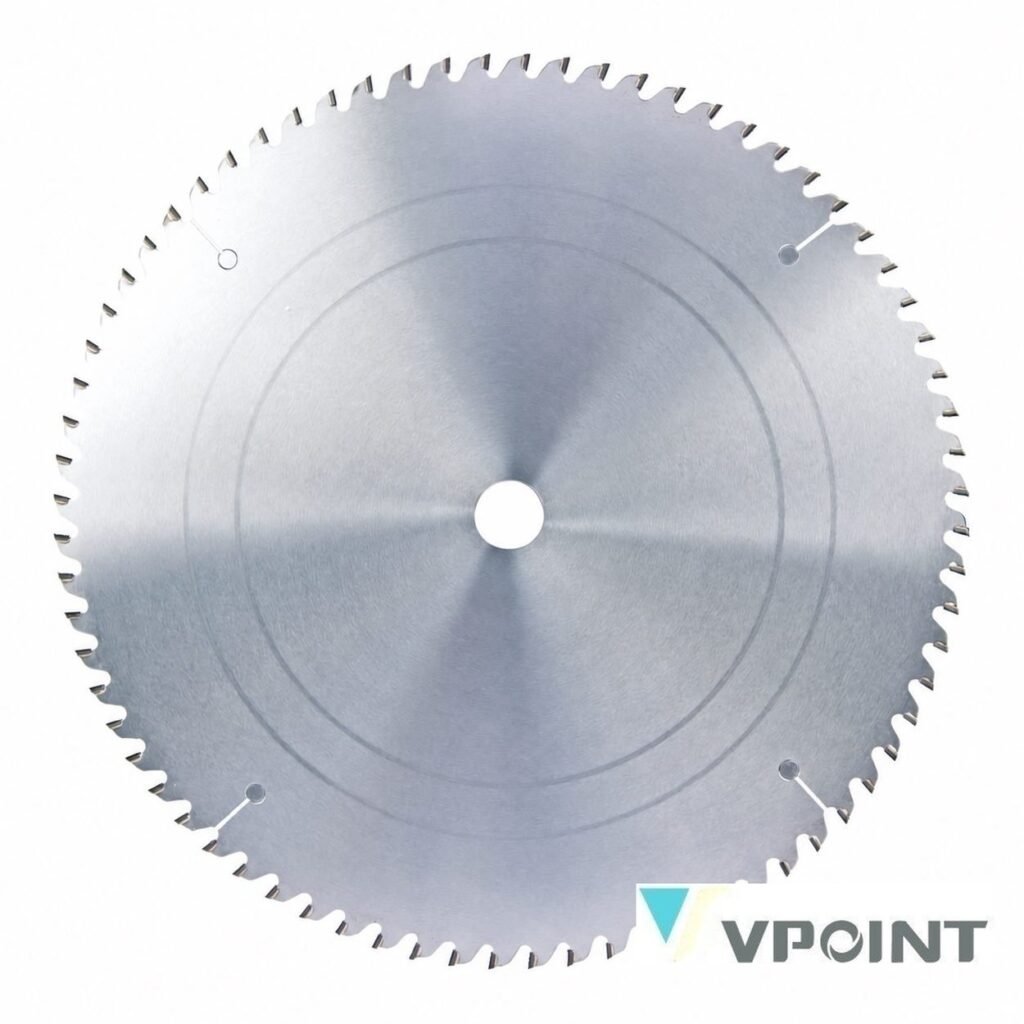
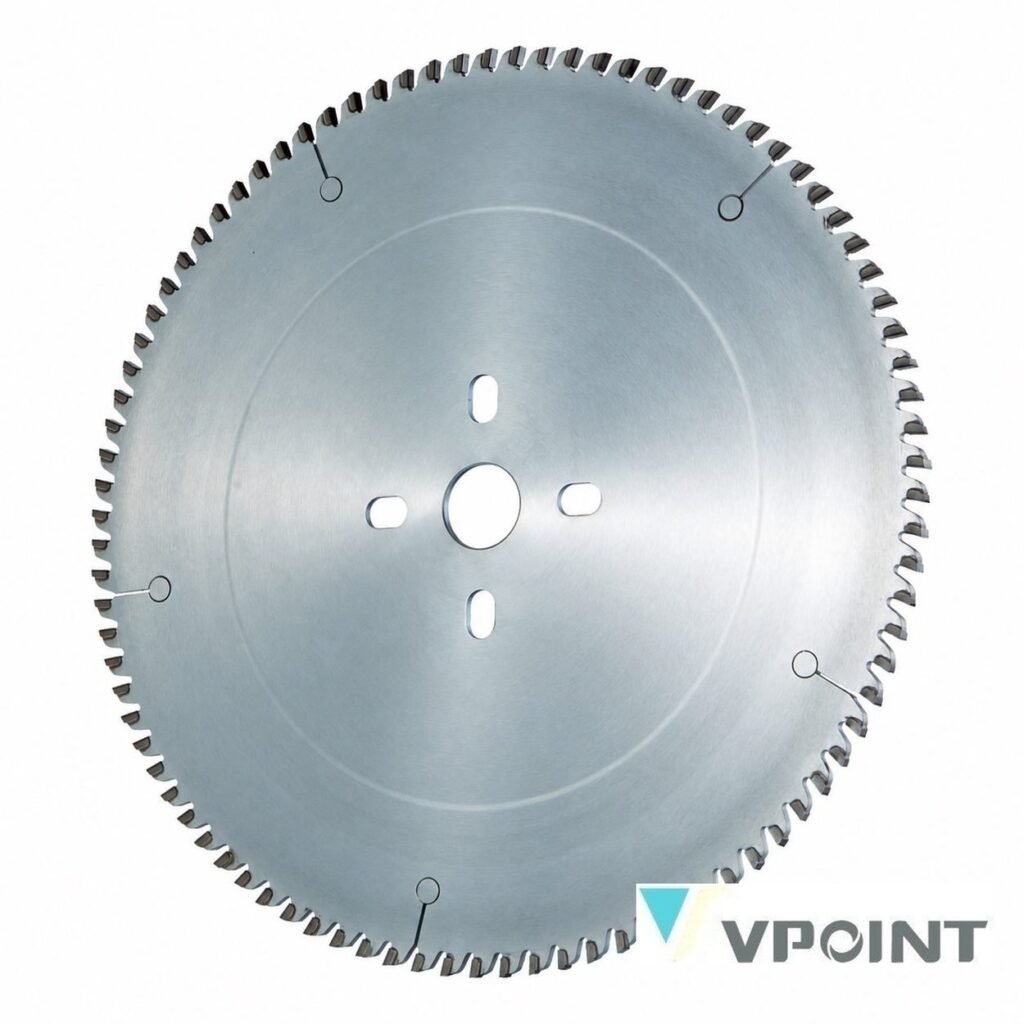
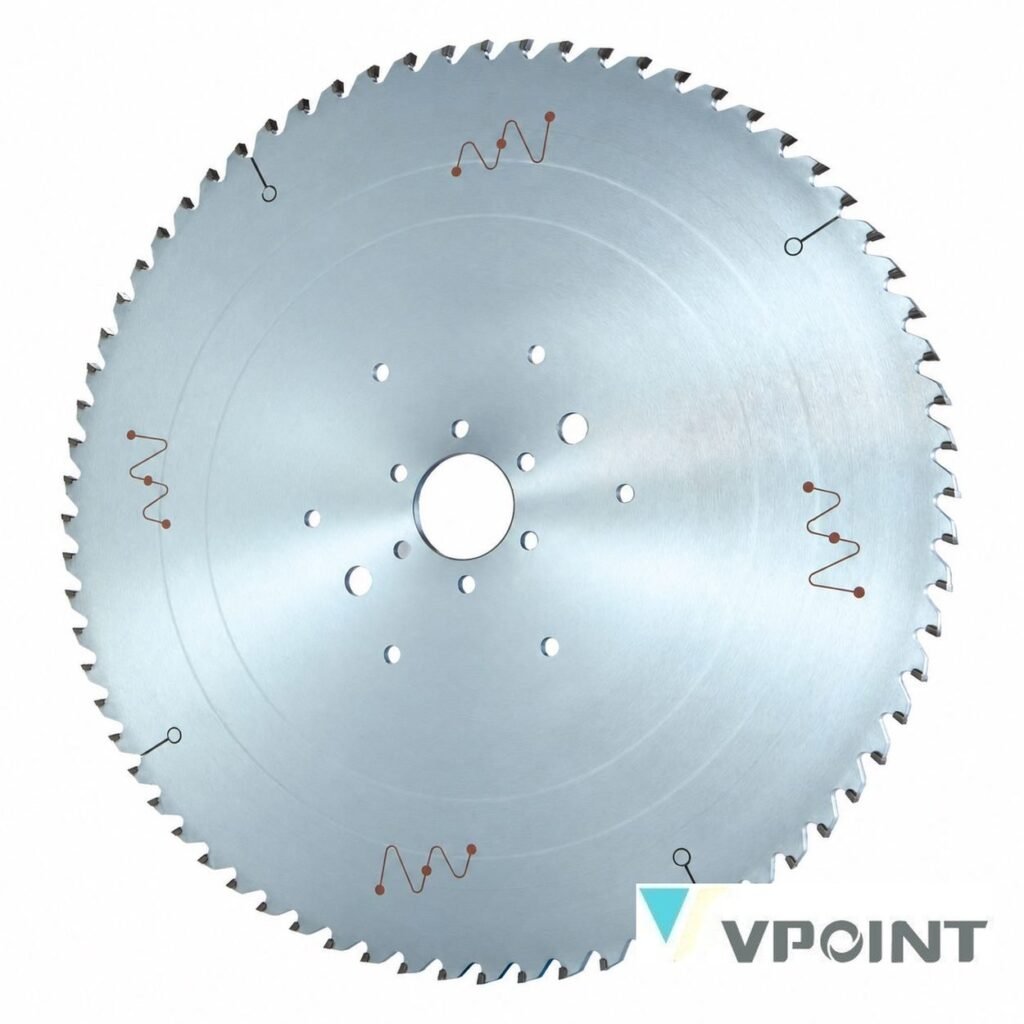
PCD Scoring Saw Blade for Panel and Wood Processing — a VPOINT saw tool for panel sizing and beam saws, sized for MDF / HDF and similar workpieces. The specification table below lists dimensions; the performance data table gives standard reference speeds and feeds to start with, and the FAQ covers selection, parameters and service. ISO 9001 production, batch-verified, custom sizes from drawings.
PCD Scoring Saw Blade for Panel and Wood Processing
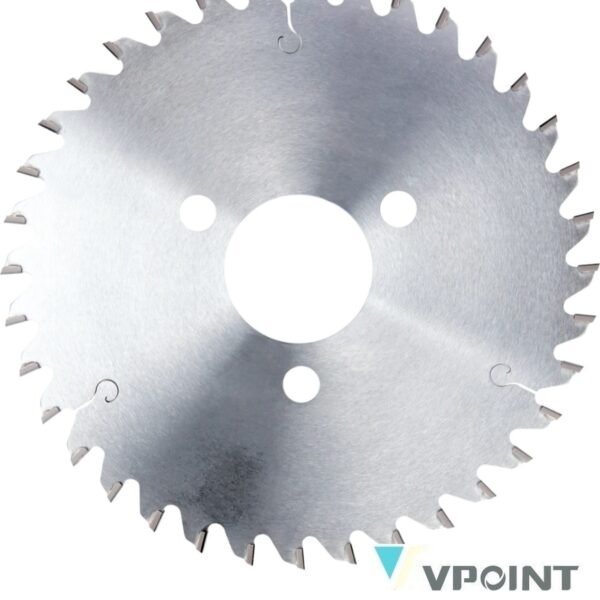
This PCD scoring saw blade is offered for scoring operations in woodworking and furniture production, matched to the main blade ahead of panel sizing. The application list includes particleboard, double-faced panels, solid wood and hardwood.
Design and Construction
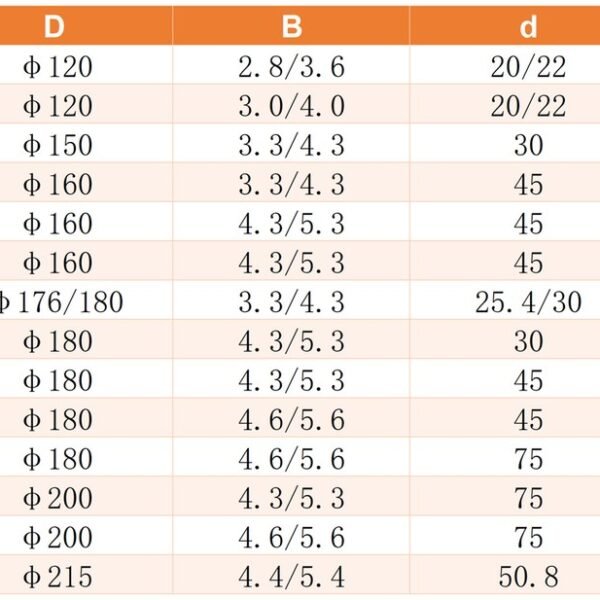
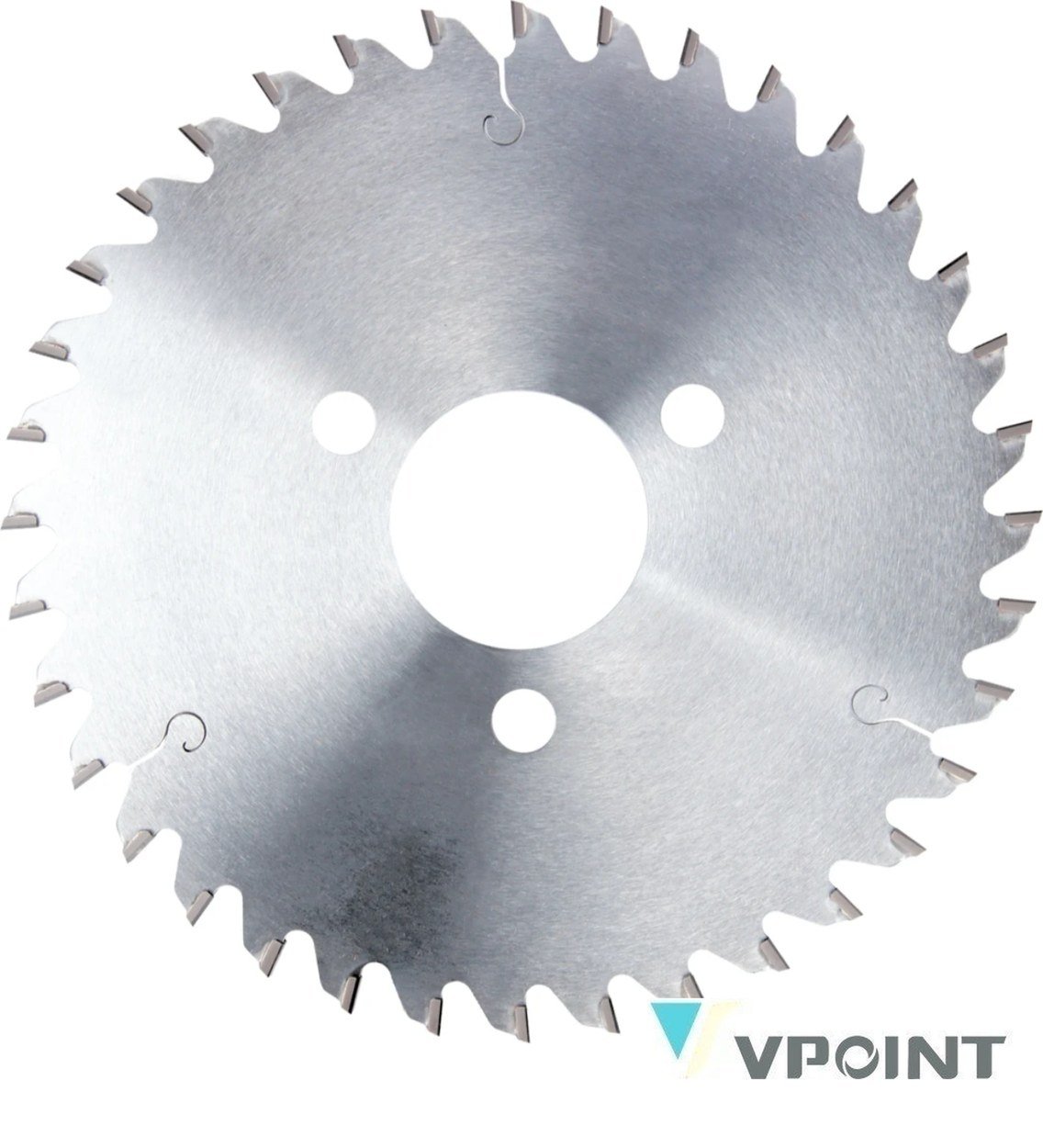
Polycrystalline diamond (PCD) teeth are brazed into a thin steel plate sized for the scoring unit. Model series PSB02001–PSB02014 cover diameters from φ120 to φ215 mm, kerfs from 2.8/3.6 to 4.6/5.6 mm, bores from 20/22 to 75 mm and tooth counts from 12+12 to 42, with conical (3.3/4.3) kerf options. The series is produced in the Sichuan and Dongguan, China manufacturing bases.
How It Works
Running counter-rotating ahead of the main blade, the scoring blade pre-cuts a shallow kerf in the panel underside so the main blade breaks fibres inward. The PCD edge keeps the scoring width stable over long runs, which keeps the lower face of every panel free of chipping.
Applications
- Scoring operations in woodworking and furniture production, ahead of the main sizing blade
- Panel production lines with scoring units on beam saws and sliding table saws
Suitable Materials
- Particleboard, double-faced panels, solid wood and hardwood, subject to grade and application review
- Suitability depends on the specific material grade, machine condition and machining parameters; confirm the application before ordering
Material Comparison: Traditional Carbide-Tipped Saw Blade vs. Diamond (PCD) Saw Blade
Typical industry data for reference. Actual results depend on the workpiece grade, machine condition and feed rate.
| Property | Traditional Carbide-Tipped Saw Blade | Diamond (PCD) Saw Blade |
|---|---|---|
| Cutting material hardness | 1,500–2,000 HV | 7,000–9,000 HV |
| Edge life on MDF / particleboard | Baseline (1×) | 15–20× longer edge life |
| Edge life on solid wood | Baseline (1×) | 10–13× longer edge life |
| Edge life on laminate / compact board | Baseline (1×) | 10–15× longer edge life |
| Sharpening cycles | 2–4 times | 5–8 times |
| Cut edge quality | Ra 0.4–0.8 µm, more fuzzing | Ra 0.2–0.4 µm, cleaner edge |
| Thermal conductivity | ≈ 100 W/m·K | ≈ 500 W/m·K, heat cleared faster |
| Friction coefficient | ≈ 0.3 | ≈ 0.05–0.1, lower cutting force |
| Chipping risk on brittle boards | Higher at high feed | Lower, stable edge at high feed |
| Cost per metre of cutting | Higher over long runs | Lower over long runs |
Delivery Scope
Model references PSB02001, PSB02003, PSB02005, PSB02008 and PSB02010 are listed for this blade; further codes in the PSB02 series are produced to order.
Each order also includes an inspection record. Send the saw make and model, scoring-unit setup, main-blade kerf, required scoring diameter and bore, panel material and surface finish so the configuration is confirmed before production.
Why Choose VPOINT
VPOINT supports this saw blade series with:
- One-year warranty on every saw blade
- Custom diameters, kerfs, bores and tooth counts produced to order
- Regrinding service to extend blade life
- Factory direct since 2008, ISO 9001 certified
- Dual manufacturing bases in Sichuan and Dongguan, China
Precision & Quality Control
Every scoring saw blade is inspected before shipment: diameter, bore, kerf, plate flatness and tooth geometry are checked against the specification table at micron level. Production follows an ISO 9001 process with batch traceability, so reorders match the original configuration.
Specifications
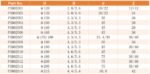
The table below reproduces the model references listed on the original chart; the full dimensional chart follows. D is blade diameter, B kerf width, d bore and Z tooth count, in millimetres; conical kerfs are shown as two values.
| Series | Model references |
|---|---|
| 金刚石划线锯片 (PCD scoring saw blade) | PSB02001, PSB02003, PSB02005, PSB02008, PSB02010 |
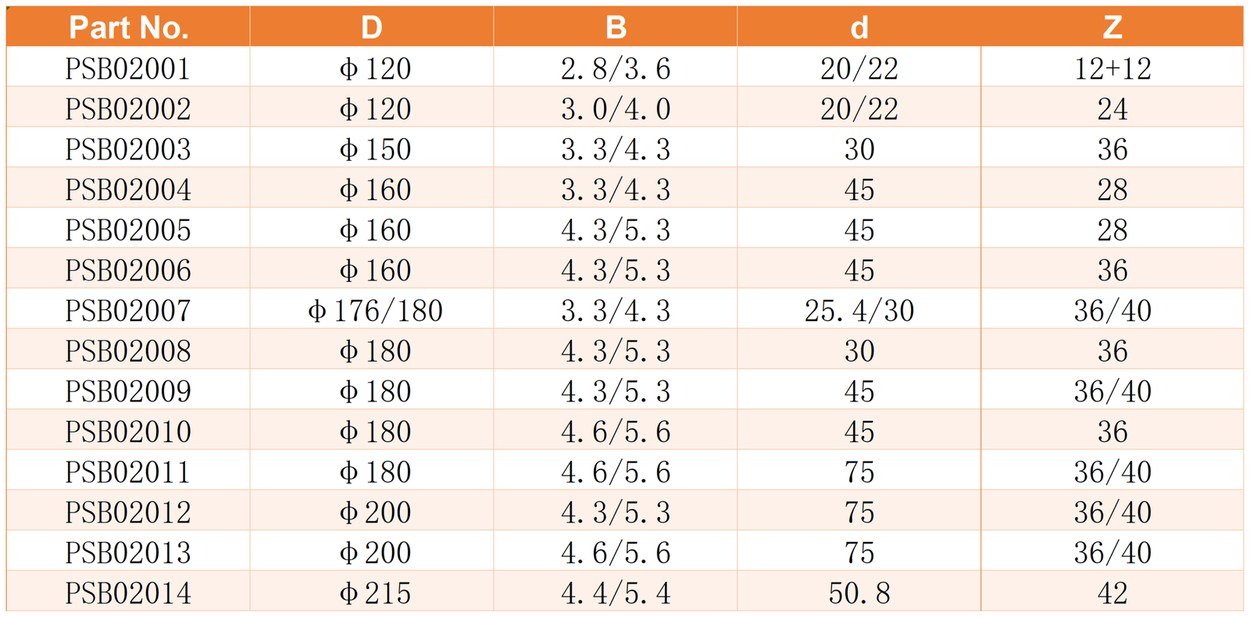
Original specification chart, PSB02001–PSB02014 (D φ120–215, B 2.8/3.6–4.6/5.6, Z 12+12–42)
Performance Data
Standard reference values for guidance only — set final speeds by blade diameter and tooth count, and confirm on the actual panel stack.
| Material | Typical spindle speed | Typical feed | Notes |
|---|---|---|---|
| MDF / HDF | 5,000–6,500 rpm | 9–16 m/min | Smooth kerf, minimal edge fuzzing |
| fibre cement / mineral panels | 3,500–4,500 rpm | 5–10 m/min | Dust extraction mandatory; PCD excels here |
Frequently Asked Questions
Which diameters and kerfs are available?
Model codes PSB02001 through PSB02014 cover diameters from 120 to 215 mm with kerfs from 2.8/3.6 to 4.6/5.6 mm, including conical scoring kerfs, as shown in the chart.
How is the scoring blade matched to the main blade?
The scoring width must suit the main-blade kerf and the scoring-unit adjustment range. Send the main-blade kerf, required scoring diameter and bore, rotation and saw model so the pairing is confirmed.
Can it work on my beam saw?
Send the saw make and model and the scoring-unit setup; the specification is confirmed against that information rather than by model code alone.
What should I send for a quotation?
Main-blade kerf, scoring diameter and bore, rotation, panel coating and saw model, plus a current-blade photo or model reference where available.
What spindle speed suits MDF / HDF?
Set the saw arbor near 5,000–6,500 rpm with the feed around 9–16 m/min; final speed depends on blade diameter and tooth count — larger diameters run slower.
How long do PCD teeth last compared with TCT saw blades?
On abrasive chipboard and MDF, PCD teeth typically run 10–20 times longer than TCT before needing service, which is why panel-sizing lines standardise on PCD.
How do I choose the tooth count?
More teeth give a cleaner edge on thin or melamine-faced panels; fewer teeth clear chips faster on thick, gummy stock. Match the tooth pitch to your feed rate.
Key words: PCD scoring saw blade, diamond scoring blade, panel scoring saw blade, conical scoring saw blade, PCD saw blade, diamond saw blade, panel sizing saw blade, PCD scoring blade, diamond tip circular saw, saw blade, panel saw blade, scoring saw blade, circular saw blade, carbide saw tips, TCT saw blade, reversible knives, rota-tip bit, constant cutting diameter, rotate insert 90 degrees, double the cutting life, on-machine knife change, ER collet, 1/2-inch shank insert bit, furniture manufacturing, furniture factory, cabinet making, acrylic sheet, solid wood, particleboard, chipboard, plywood, rubber sheet, rubber board, hardwood, softwood, MDF, HDF, melamine board, flycutter, planing bit, surfacing bit, slab flattening bit, bottom cleaning bit, spoilboard leveller, rabbeting bit
Sources & standards: ISO 9001 quality management · UNSPSC commodity codes · eClass product classification
Related Search Terms
PCD saw blade, diamond saw blade, panel sizing saw blade, PCD scoring blade, diamond tip circular saw, scoring, blade