
- PCD Tools For Wood
- Replaceable Insert Router Bits
- CNC End Mill
- Cutter Head
- Woodworking Tools
- Industries Knives
- Carbide Burr
- Carbide Rotary Burr
- Tungsten Carbide Burr Bits
- Tungsten Carbide Burr Set
- Cylindrical Carbide Burr
- Long Shank Carbide Burr
- Double Cut Carbide Burr
- Flame Carbide Burr
- Cone Carbide Burr
- Burr Blanks
- Carbide Rods
- Tire Reamer Bit
- Tungsten Carbide End Mill
- Carbide Tire Studs
- Snow Tire Studs
- ATV Tire Studs
- Motorcycle Tire Studs
- Mining & Oiling
A cutter head is a tool used in various industrial

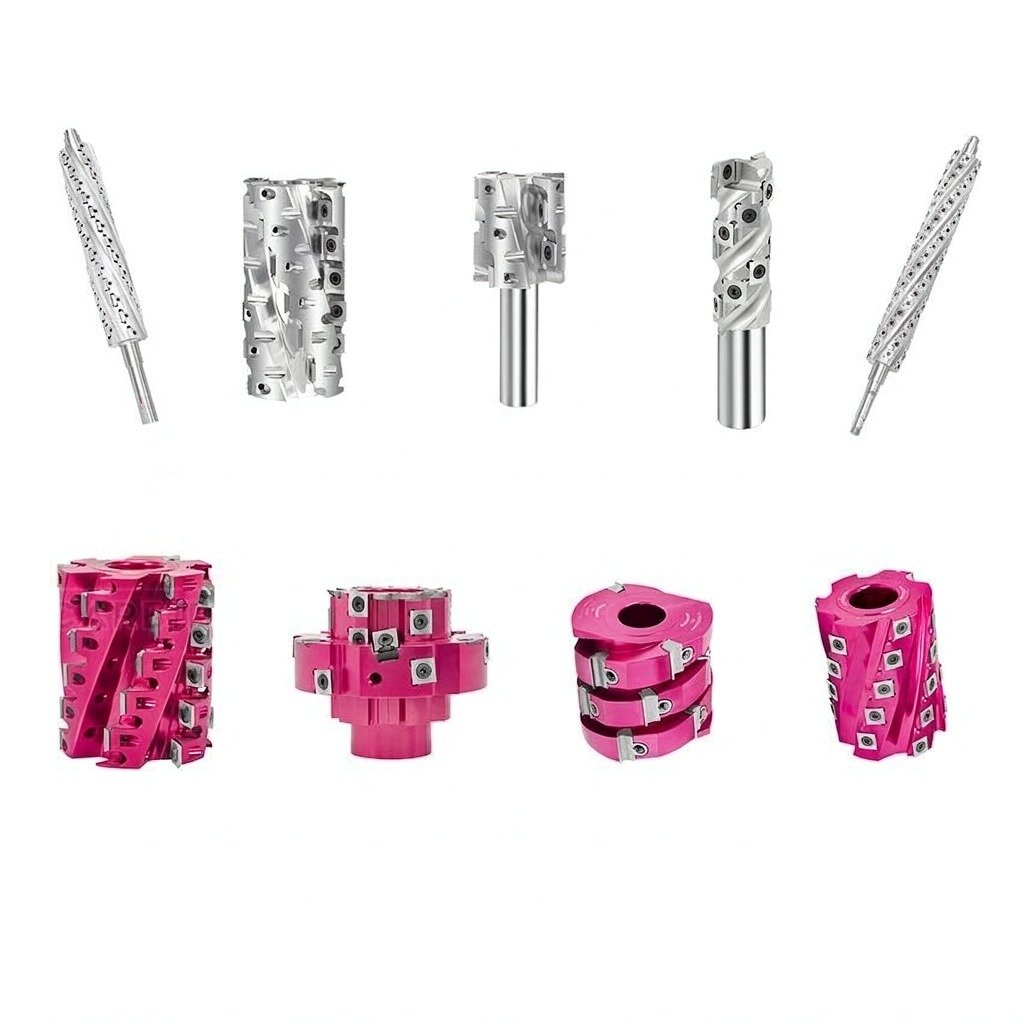
Design and Construction — a VPOINT CNC spiral cutterhead balanced for high-speed panel work, sized for solid wood (pine, maple, oak) and similar stock. Cutterheads run slower than router bits — start near 8,000–12,000 rpm with the feed around 6–12 m/min (standard reference values below). 15×15×2.5 mm TCT inserts, rotate a fresh edge in seconds, aluminium-alloy or steel bodies. ISO 9001 production, batch-verified.
Design and Construction
This cutter head page covers the general industrial cutter-head programme: steel-body heads carrying indexable inserts for planing, moulding and jointing operations. Head diameter, width, bore and insert configuration are matched to the machine when ordering.
How It Works
As the head spins, the helical rows of inserts cut a continuous shearing arc: cutting force stays low, noise drops, and the finish shows the characteristic sheared-surface look instead of ripple marks. When an edge dulls, the insert is turned to its second edge or swapped in minutes — the head, its mounting and its balance stay on the spindle.
Applications
- Planing and moulding spindle heads
- Jointing heads
- Insert-system cutterhead programmes
- Custom head requirements
Suitable Materials
- Solid wood
- MDF and particleboard
- Plywood and veneered panels
- Laminated boards

Indexable inserts keep fresh edges on the head across industrial cutting programmes.
System Comparison: Replaceable Insert vs. Solid Knife
Insert cutterheads keep the steel body in service and replace only the cutting edges. For production planing and jointing, this is usually the lower-cost way to hold edge quality.
| Property | Replaceable Insert Knife (This Tool) | Solid Profile Knife |
|---|---|---|
| Edge replacement | Swap the worn insert only; the steel body stays in service | Regrind or replace the complete tool |
| Body material | 40Cr chrome-molybdenum steel body, reused across insert changes | Whole tool consumed as the edge wears |
| Downtime per edge change | Minutes — index or swap the insert | Send out for regrinding or buy a new tool |
| Profile changes | Fit a different insert geometry to the same body | New tool required per profile |
| Edge condition | Fresh edge on every change; consistent cut quality | Edge quality drifts between regrinds |
| Best suited for | Production cutterheads with repeat profiles | One-off profiles and low-volume work |
Solid knives remain the better choice for one-off profiles and very low volumes.
Delivery Scope
Single cutterhead. Order by the diameter, width, bore and tooth count stated in the specifications table below (inserts sold separately).
Why Choose VPOINT
- One-year warranty on every cutter — defects in material or workmanship are covered for 12 months from delivery.
- Custom tooling — diameters, shanks, cutting lengths and flute configurations built to your drawing or sample.
- Non-standard fabrication — sizes outside the standard catalogue, including special geometries.
- Resharpening service — cutters return to service after regrinding at a fraction of new-tool cost.
- Factory-direct since 2008 — ISO 9001 manufacturing in Sichuan and Dongguan, China; no trading intermediaries.
Send a drawing, a sample or a worn tool, and our engineering team will quote the exact specification you need.
Precision & Quality Control
Every cutter is inspected before shipment. Shank diameter, cutting-edge diameter, cutting length and overall length are measured against the values listed in the specifications table, and cutting edge runout is verified on the assembled tool.
Tools measuring outside tolerance do not ship. Inspection is performed under our ISO 9001 quality system, with batch records retained for traceability.
Specifications
| Parameter | How to specify |
|---|---|
| Outside diameter (ØD) | State the blade diameter, or your machine model |
| Kerf / plate thickness | State both thicknesses, or send the old blade as a sample |
| Bore (Ød) | State the spindle bore; bore-reduction rings available |
| Tooth count (Z) and tooth type | State the tooth count; tooth geometry is matched to the material |
| Custom sizes | Send a drawing or sample — built to order |
Key words: industrial cutter head, insert cutterhead, planing head, moulding cutterhead, spiral cutterhead, helical cutter head, planer cutter head, insert cutter head, spiral cutter head with indexable knives, system planer knives, profile knives, cutter head for spindle moulder, jointing cutter head, replaceable knife cutter head, helical planer head, TCT insert cutter head, reversible knives, rota-tip bit, constant cutting diameter, rotate insert 90 degrees, double the cutting life, on-machine knife change, ER collet, furniture manufacturing, furniture factory, cabinet making, acrylic sheet, solid wood, particleboard, chipboard, plywood, rubber sheet, rubber board, hardwood, softwood, MDF, HDF, melamine board, flycutter, planing bit, surfacing bit, slab flattening bit, bottom cleaning bit, spoilboard leveller, rabbeting bit
Performance Data
Standard reference values for guidance only — cutterhead speed depends on head diameter and machine; confirm on the actual machine and stock.
| Material | Typical spindle speed | Typical feed | Notes |
|---|---|---|---|
| solid wood (pine, maple, oak) | 8,000–12,000 rpm | 6–12 m/min | Helical insert placement gives a shearing cut |
| MDF / particleboard | 8,000–12,000 rpm | 6–12 m/min | Inserts hold edge through abrasive glue lines |
| veneered panels | 8,000–12,000 rpm | 6–10 m/min | Lower tear-out than straight-knife heads |
Frequently Asked Questions
What spindle speed and feed should I start with on solid wood (pine, maple, oak)?
+Cutterheads run slower than router bits: begin near 8,000–12,000 rpm with the feed around 6–12 m/min, then tune for the finish you want — the helical insert placement shears the fibres instead of chopping them.
Why a spiral insert cutterhead instead of a straight-knife head?
+Helical placement gives a shearing cut: noticeably lower noise, lighter machine load and far less tear-out on figured stock. Inserts rotate in seconds, so a dull edge never stops the run.
Aluminium body or steel body?
+Aluminium keeps the head light for weight-sensitive spindles; steel adds mass and rigidity for heavy cuts. Both use the same 15×15×2.5 mm TCT inserts.
Sources & standards: ISO 9001 quality management · UNSPSC commodity codes · eClass product classification
Related Search Terms
spiral cutterhead, helical cutter head, planer cutter head, insert cutter head, spiral cutter head with indexable knives, system planer knives, profile knives, cutter head for spindle moulder, jointing cutter head, replaceable knife cutter head, helical planer head, TCT insert cutter head, cutter, various, industrial

Reviews
There are no reviews yet.