- PCD Tools For Wood
- Replaceable Insert Router Bits
- CNC End Mill
- Cutter Head
- Woodworking Tools
- Industries Knives
- Carbide Burr
- Carbide Rotary Burr
- Tungsten Carbide Burr Bits
- Tungsten Carbide Burr Set
- Cylindrical Carbide Burr
- Long Shank Carbide Burr
- Double Cut Carbide Burr
- Flame Carbide Burr
- Cone Carbide Burr
- Burr Blanks
- Carbide Rods
- Tire Reamer Bit
- Tungsten Carbide End Mill
- Carbide Tire Studs
- Snow Tire Studs
- ATV Tire Studs
- Motorcycle Tire Studs
- Mining & Oiling

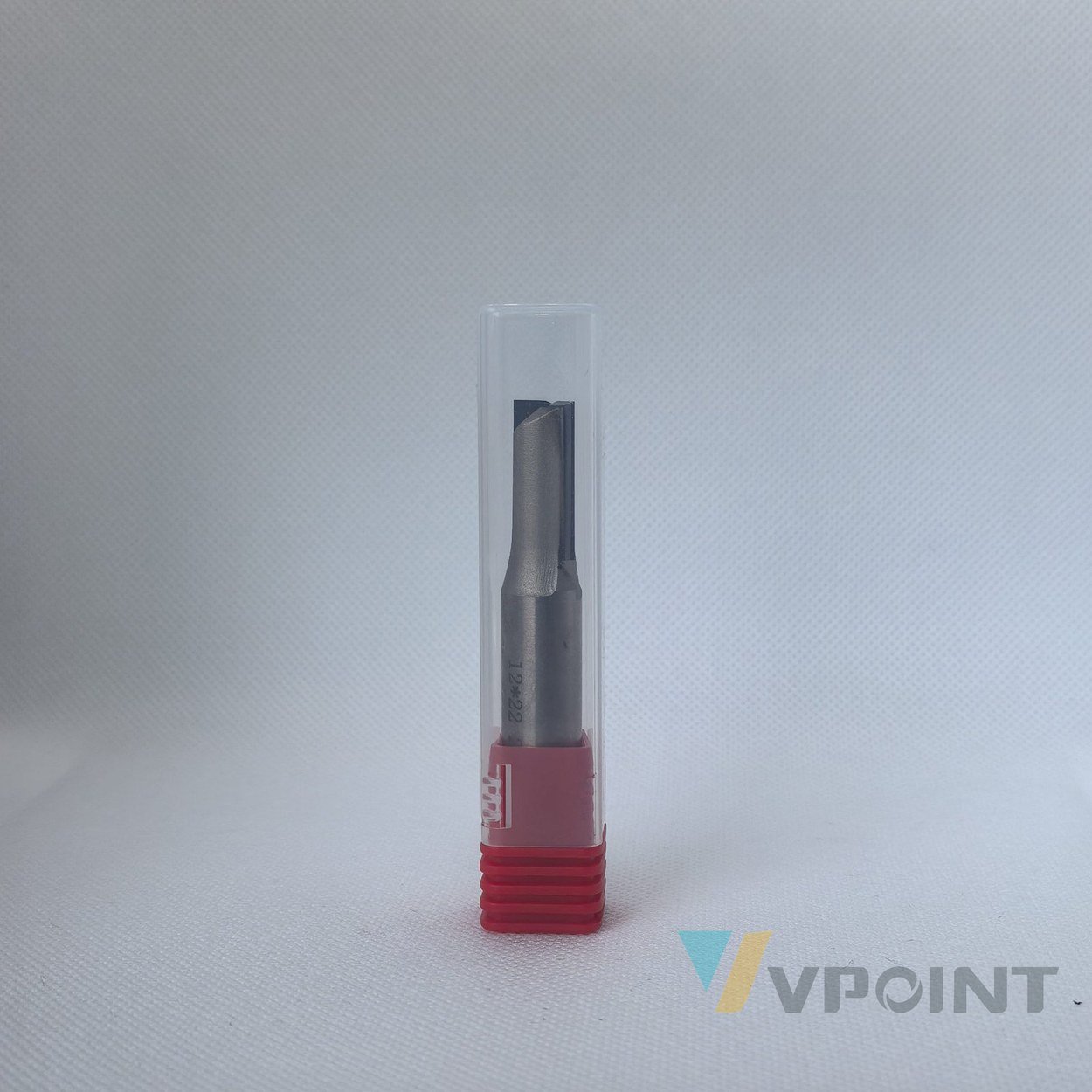


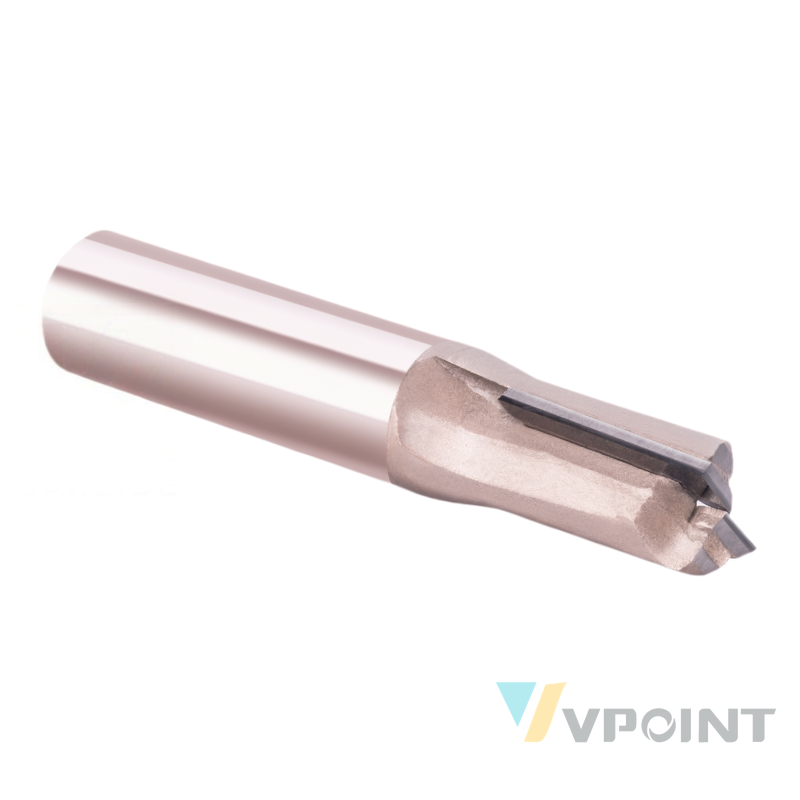
PCD Straight Bits With Bottom Tip for CNC Woodworking — a VPOINT PCD straight router bit for flat-bottom grooving and spoilboard work, sized for MDF and similar workpieces. Start near 20,000–24,000 rpm / 10–15 m/min (standard reference values in the performance table below); the specification table lists diameters, cut lengths and shanks. Diamond edges hold 15–20× carbide life on abrasive panels. ISO 9001 production, batch-verified, custom sizes from drawings.
PCD Straight Bits With Bottom Tip for CNC Woodworking
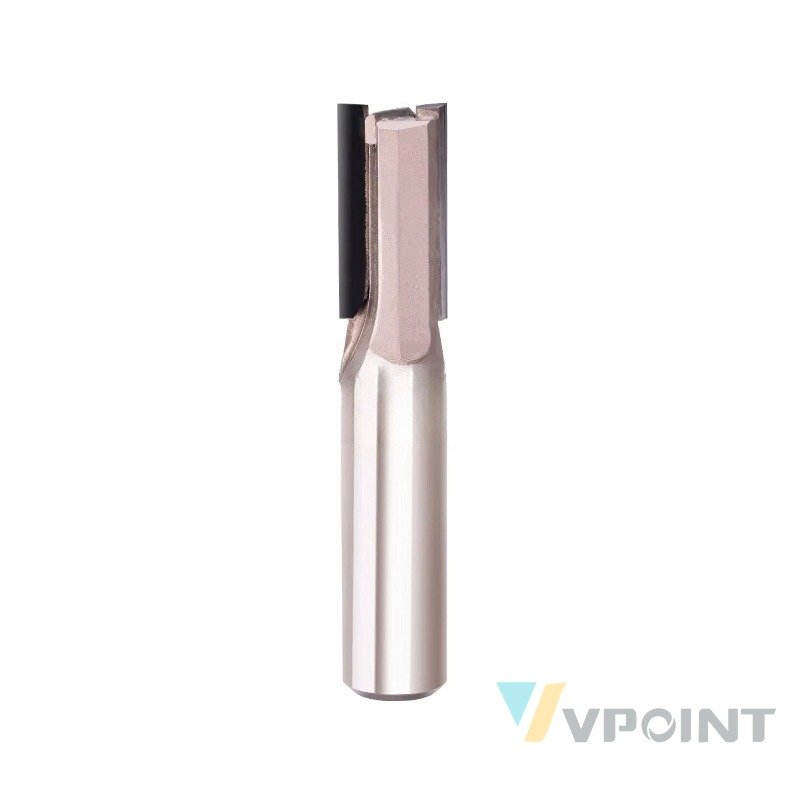
Straight bits with a PCD bottom tip clean and smooth pre-cut dadoes and handle compatible resurfacing work on CNC woodworking machines. Fourteen configurations cover cutting diameters from 5 to 20 mm with cutting heights from 12 to 30 mm, all on 12.7 mm shanks with 2 teeth.
Design and Construction
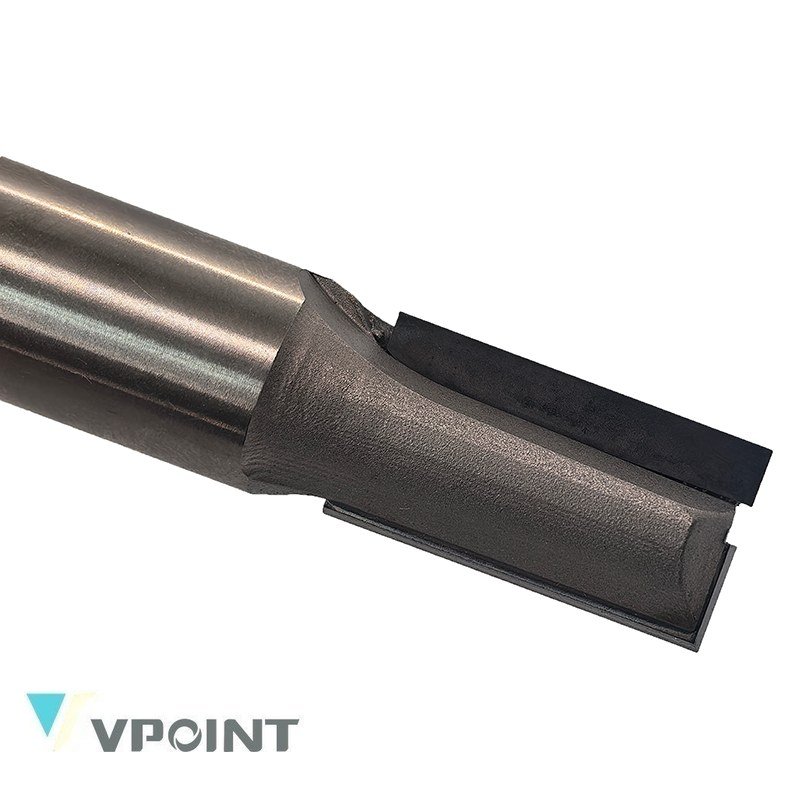
+The straight flutes and the PCD bottom tip are carried on a 40Cr chrome-molybdenum steel body. The bottom tip is a separate polycrystalline diamond cutting edge brazed at the end of the tool, so both the flute edges and the tool centre cut. The series is produced in the Sichuan and Dongguan, China manufacturing bases.
How It Works
+The straight flutes shear the walls of the groove while the bottom tip cuts at the centre of the tool, where straight flutes alone leave a nub. Plunging into the pre-cut dado, the bit planes the floor smooth and squares the groove bottom in one pass. Compare cutting diameter and height with the existing groove and required depth before machining.
Applications
- Cleaning and smoothing pre-cut dadoes
- Compatible resurfacing work
- For compatible CNC woodworking machines, engraving machines and routing machines
Suitable Materials
- Wood, MDF, plywood and composite workpieces
- Suitability depends on the specific material grade, profile and machining conditions; confirm the application before ordering
Material Comparison: Traditional Brazed Tungsten Carbide vs. Diamond (PCD) Router Bit
+Typical industry data for reference. Actual results depend on the workpiece grade, machine condition and feed rate.
| Property | Traditional Brazed Tungsten Carbide Router Bit | Diamond (PCD) Router Bit |
|---|---|---|
| Cutting material hardness | 1,500–2,000 HV | 7,000–9,000 HV |
| Edge life on MDF / particleboard | Baseline (1×) | 15–20× longer edge life |
| Edge life on solid wood | Baseline (1×) | 10–13× longer edge life |
| Edge life on acrylic | Baseline (1×) | 10–15× longer edge life |
| Regrinding / refurbishing cycles | 2–4 times | 5–8 times |
| Cut edge quality | Ra 0.4–0.8 µm, more fuzzing | Ra 0.2–0.4 µm, cleaner edge |
| Thermal conductivity | ≈ 100 W/m·K | ≈ 500 W/m·K, heat cleared faster |
| Friction coefficient | ≈ 0.3 | ≈ 0.05–0.1, lower cutting force |
| Chipping risk on brittle panels | Higher at high feed | Lower, stable edge at high feed |
| Cost per metre of cutting | Higher over long runs | Lower over long runs |
Delivery Scope
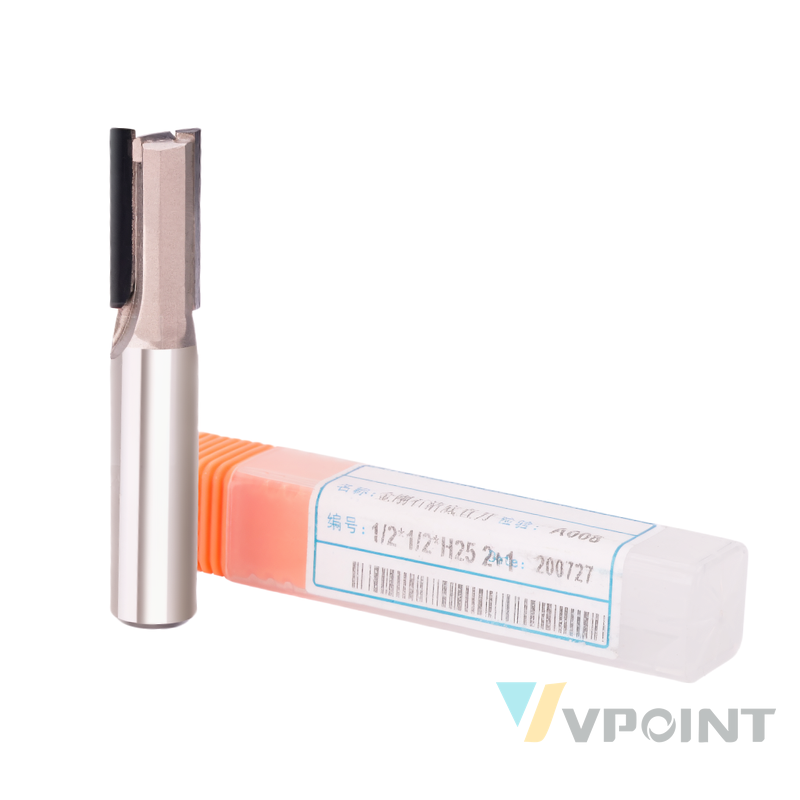
Each tool is packed in an individual plastic box.
+Each order also includes an inspection record. Custom configurations are produced after the workpiece material, machine model and required dimensions are confirmed.
Why Choose VPOINT
+VPOINT supports this series with:
- One-year warranty on every router bit
- Custom and non-standard diameters, cutting heights and shanks produced to order
- Regrinding service to extend tool life
- Factory direct since 2008, ISO 9001 certified
- Dual manufacturing bases in Sichuan and Dongguan, China
Precision & Quality Control
+Every straight bit with bottom tip is inspected before shipment: cutting diameter, shank diameter, cutting height and tool runout are checked against the specification table at micron level. Production follows an ISO 9001 process with batch traceability, so reorders match the original configuration.
Specifications
The table below is transcribed from the original specification chart. All dimensions are in millimetres. D is cutting diameter, H is cutting height, d is shank diameter, L is overall length and Z is tooth count. Each row is a separate configuration.
| Item code | D (mm) | H (mm) | d (mm) | L (mm) | Z |
|---|---|---|---|---|---|
| LH04001 | 5 | 12 | 12.7 | 62 | 2 |
| LH04002 | 6 | 15 | 12.7 | 63 | 2 |
| LH04003 | 6 | 20 | 12.7 | 68 | 2 |
| LH04004 | 8 | 15 | 12.7 | 63 | 2 |
| LH04005 | 8 | 20 | 12.7 | 68 | 2 |
| LH04006 | 10 | 20 | 12.7 | 68 | 2 |
| LH04007 | 12.7 | 22 | 12.7 | 67 | 2 |
| LH04008 | 12.7 | 30 | 12.7 | 75 | 2 |
| LH04009 | 16 | 20 | 12.7 | 65 | 2 |
| LH04010 | 16 | 30 | 12.7 | 75 | 2 |
| LH04011 | 18 | 20 | 12.7 | 65 | 2 |
| LH04012 | 18 | 30 | 12.7 | 75 | 2 |
| LH04013 | 20 | 20 | 12.7 | 65 | 2 |
| LH04014 | 20 | 30 | 12.7 | 75 | 2 |
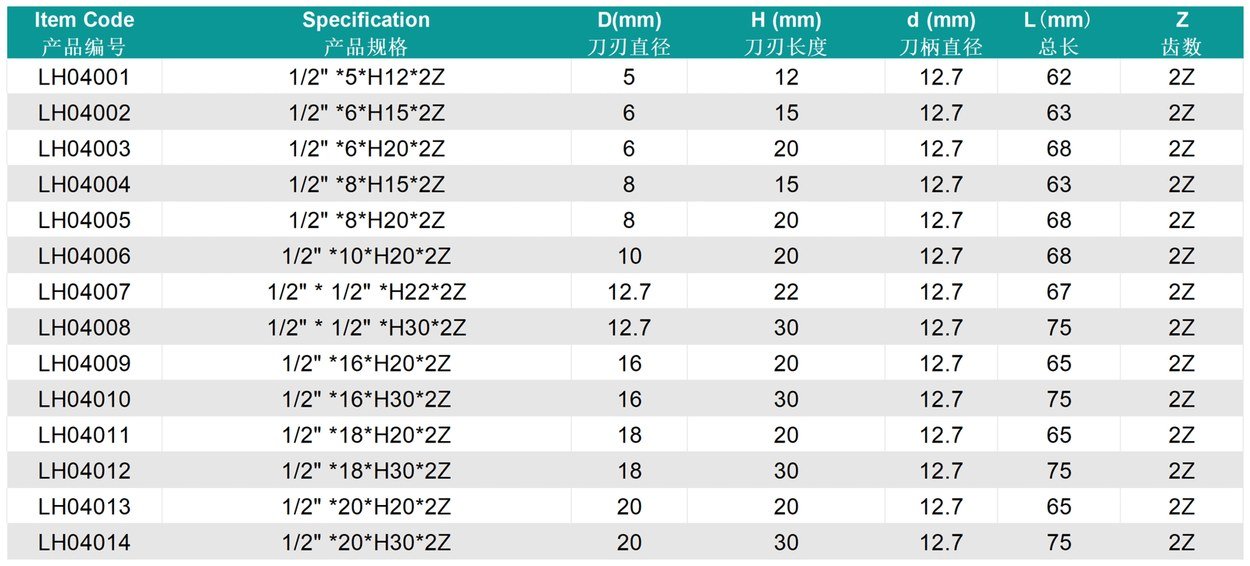
Original specification chart with 14 configurations

Bottom tip profile with D, H, d and L dimensions
Performance Data
Standard reference values for guidance only — always adjust to machine rigidity, clamping and tool wear, and confirm on the actual workpiece.
| Material | Typical spindle speed | Typical feed | Notes |
|---|---|---|---|
| MDF | 20,000–24,000 rpm | 10–15 m/min | PCD holds edge on abrasive MDF |
| particleboard | 18,000–22,000 rpm | 8–12 m/min | Grit-resistant diamond edges |
Frequently Asked Questions
Which diameters and cutting heights are available?
+Fourteen configurations with cutting diameters from 5 to 20 mm and cutting heights of 12, 15, 20, 22 or 30 mm. All use a 12.7 mm shank with 2 teeth; overall length runs from 62 to 75 mm.
Why does a straight bit need a bottom tip?
+Straight flutes alone leave an uncut nub at the centre when plunging. The brazed PCD bottom tip cuts at the tool centre, so the groove floor is finished square and smooth in one pass.
What is the difference between this and the bottom cleaning series?
+Both clean dado floors. The bottom cleaning series is a dedicated floor-planing geometry in larger diameters (15 to 60 mm); this series adds straight-flute wall cutting in smaller diameters (5 to 20 mm).
What should I send for selection?
+The groove width and depth, workpiece material, machine model, collet size and spindle limits, plus a drawing or photo of the current tool where available.
+Key words: PCD straight bit bottom tip, CNC dado cleaning bit, plunge straight router bit, diamond tip straight bit, PCD straight router bit, diamond straight bit, PCD slotting cutter, PCD groove cutter, diamond tipped router bit, PCD router bit, PCD spiral router bit, diamond router bit, PCD tips, reversible knives, rota-tip bit, constant cutting diameter, rotate insert 90 degrees, double the cutting life, on-machine knife change, ER collet, 1/2-inch shank insert bit, furniture manufacturing, furniture factory, cabinet making, panel furniture, kitchen cabinet production
What feed should I start with on MDF?
+Begin near 10–15 m/min at 20,000–24,000 rpm. Straight PCD flutes cut without lifting the panel, so a steady moderate feed gives the cleanest flat bottom; tune by chip load.
Why choose PCD for straight-flute work?
+On abrasive MDF and particleboard the diamond edges last 15–20 times longer than brazed carbide (typical industry data), keeping the groove width constant across long runs.
Are these bits suitable for spoilboard surfacing?
+Yes — the bottom-cleaning versions level MDF and LDF beds evenly. Multiple passes with light overlap give the flattest table.
Sources & standards: ISO 9001 quality management · UNSPSC commodity codes · eClass product classification